Rancho Cucamonga became a city in 1977, stitched together from Alta Loma, Cucamonga and Etiwanda. Long before the tracts arrived, those communities were vineyards and citrus, and the growers planted rows of eucalyptus as windbreaks. Many of those windrows are still standing, and neighborhoods were built around them.
That leaves a lot of Rancho Cucamonga homes with an unusual arrangement: trees that are older than the house, with root systems already established when the sewer lateral was laid through the same ground.
How Roots Get Into a Sewer Lateral
Roots do not punch through sound pipe. They find openings that already exist. A lateral is a run of sections joined together, and every joint, fitting and connection is a place where a small gap can open as soil settles and shifts.
Wastewater is warm and full of nutrients, and a little vapor escapes at any gap. Roots grow toward it. A hair-thin thread gets in first, then thickens season after season until it becomes a mat that catches paper and solids. The pipe is not broken. It is occupied.
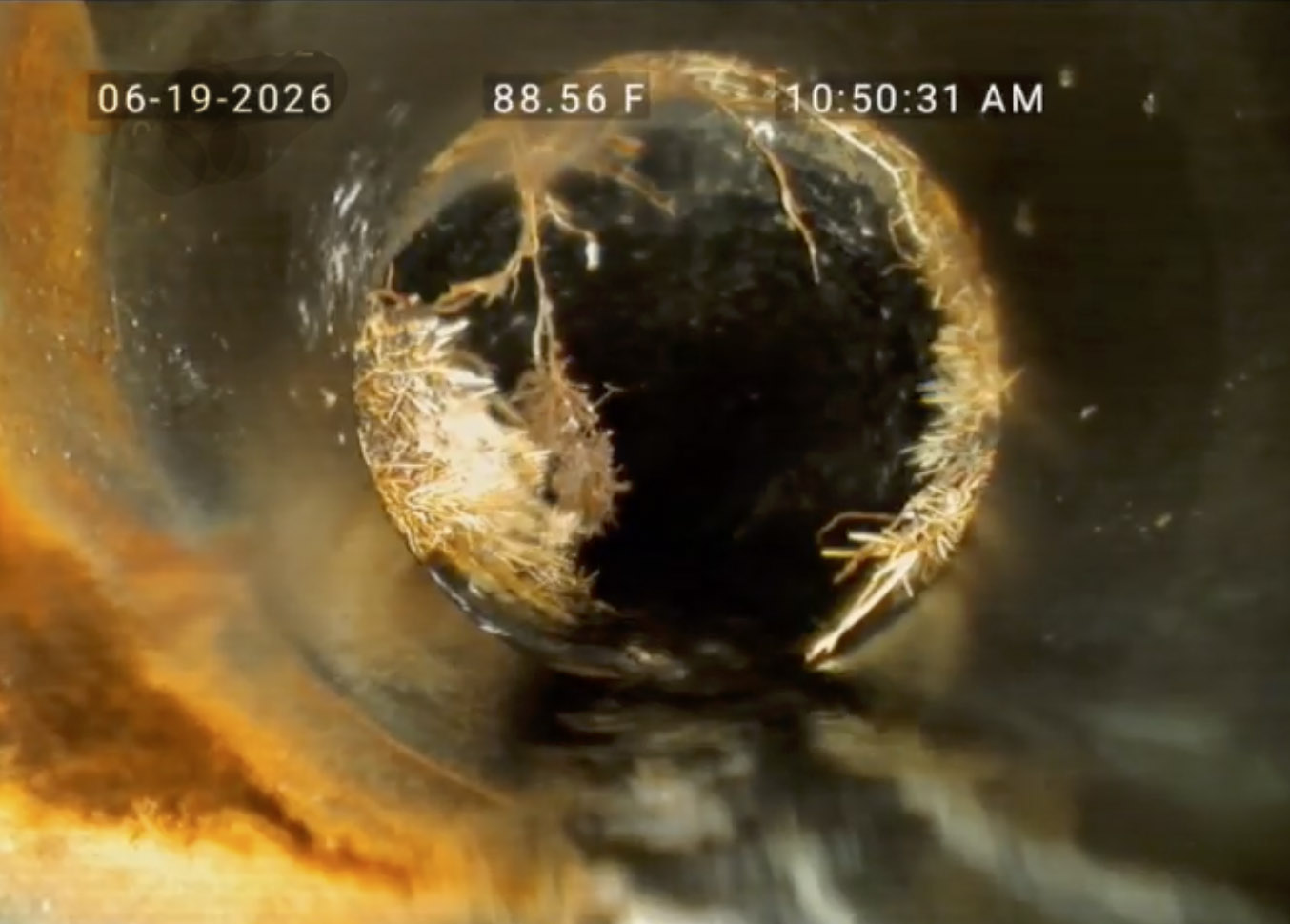
Newer Pipe Is Not Root-Proof
Much of Rancho Cucamonga was built from the late 1970s onward, and a newer house usually means plastic pipe rather than clay. Plastic resists roots far better than clay does, but it is not immune. Roots still work into fittings, transitions between materials, cleanout connections and the connection at the city main.
Alta Loma’s earlier homes and the older parts of Cucamonga are a different story. Where the original lateral is still in the ground, the joints are closer together and the materials are older, and a mature tree nearby has had decades to find them.
From the street, both look exactly the same. The only way to know which one you have is to look inside.
What a Scope Shows You
We feed the camera into the lateral at the access point and run it the full length to the city connection. You watch the live feed with us while we narrate — pipe material, every joint, anything growing in, and any low spot holding water.
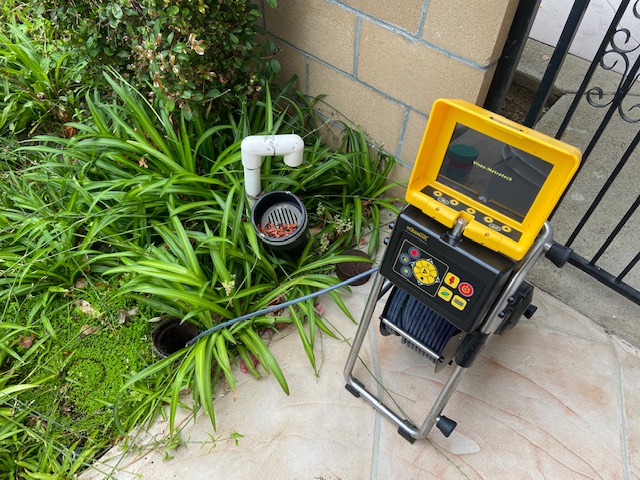
Every finding is located by cable distance from the access point, plus a mark on the surface. We never publish a depth figure. Cable footage is counted off the reel and does not change; a depth reading moves with soil, moisture and how the locator is held. Footage and a surface mark give whoever digs something they can rely on.
You get a verbal walkthrough before we leave and a written PDF report with the full video emailed the same day. Most laterals take 20 to 40 minutes.
The camera and the repair should not come from the same company. Most sewer inspections in Rancho Cucamonga are run by plumbers who also sell the fix. FlowPro IE only inspects. We do not do root cutting, excavation or lining on lines we scope, and we take no referral fee in either direction.
When to Get One
- You are in escrow — a general home inspection does not cover the sewer lateral
- A eucalyptus, pepper tree or other large tree stands between the house and the street
- Drains slow, clear, and slow again within a few months
- Gurgling from drains or toilets when water runs elsewhere
- A damp or unusually green patch in the yard or parkway
- The line has had roots cut before and you want to know how fast they are coming back
Serving Rancho Cucamonga and the Inland Empire
FlowPro IE covers Rancho Cucamonga and the surrounding Inland Empire, including Ontario, Fontana, Rialto, San Bernardino and Chino Hills. For more on roots, see our post on tree roots in Fontana sewer lines, or read what a scope turns up in San Bernardino and Ontario.
Call 714-992-6363 to schedule, or to ask whether a scope is worth it on your particular house. We will tell you if it is not.
Schedule a Sewer Scope in Rancho Cucamonga
On-site walkthrough, same-day PDF report with the full video, and no repair quote attached.
714-992-6363 Call to Schedule